
What to include in an investor update is the numbers that did not move the way you said they would, the cash, and the list from last month. Leave out the tour of the office, the quote from a happy customer, and anything you would not want read back to you.
Founders ask this because a blank page is worse than a late one, and because most templates have nine sections. You do not need nine. You need the sections an investor actually looks for, in the same order every month.
A summary they can read without scrolling. Two sentences. What the month was, and whether you are on plan. This is the only paragraph some of them will read, so write it last, from the numbers, rather than first from the mood of the week.
Revenue, or the nearest thing to it. MRR if you have it. Pilots, letters of intent, or a waitlist if you do not. Use the same definition every month. Bookings are not revenue, and pipeline is not revenue.
Cash, burn, and runway. This is the block investors scroll to. Cash in the bank on the last day of the month, burn for the month, and months of runway at that burn. If runway moved for a reason other than the plan, say so in the same block.
Plan against actual. Last month you wrote a number. This month you put it next to what happened. A miss without a reason is the line they will reply to. A miss with a reason, and a date, is a normal month.
What changed. Customers won or lost, a hire, a ship, a deal that slipped. Name it. If you cannot name it, it does not belong in the investor update.
Last month’s list. Tick what you did. Defer what you did not, and keep the month it was first promised beside it. This is the part founders skip, and the part investors remember.
The next 30 days. Three items you are willing to be asked about. Not a roadmap.
An ask, if you have one. One intro, one hire, or one decision you want a view on. No ask is better than a vague one. If you have nothing to ask, leave the section out.
What to include in an investor update, and what to leave out
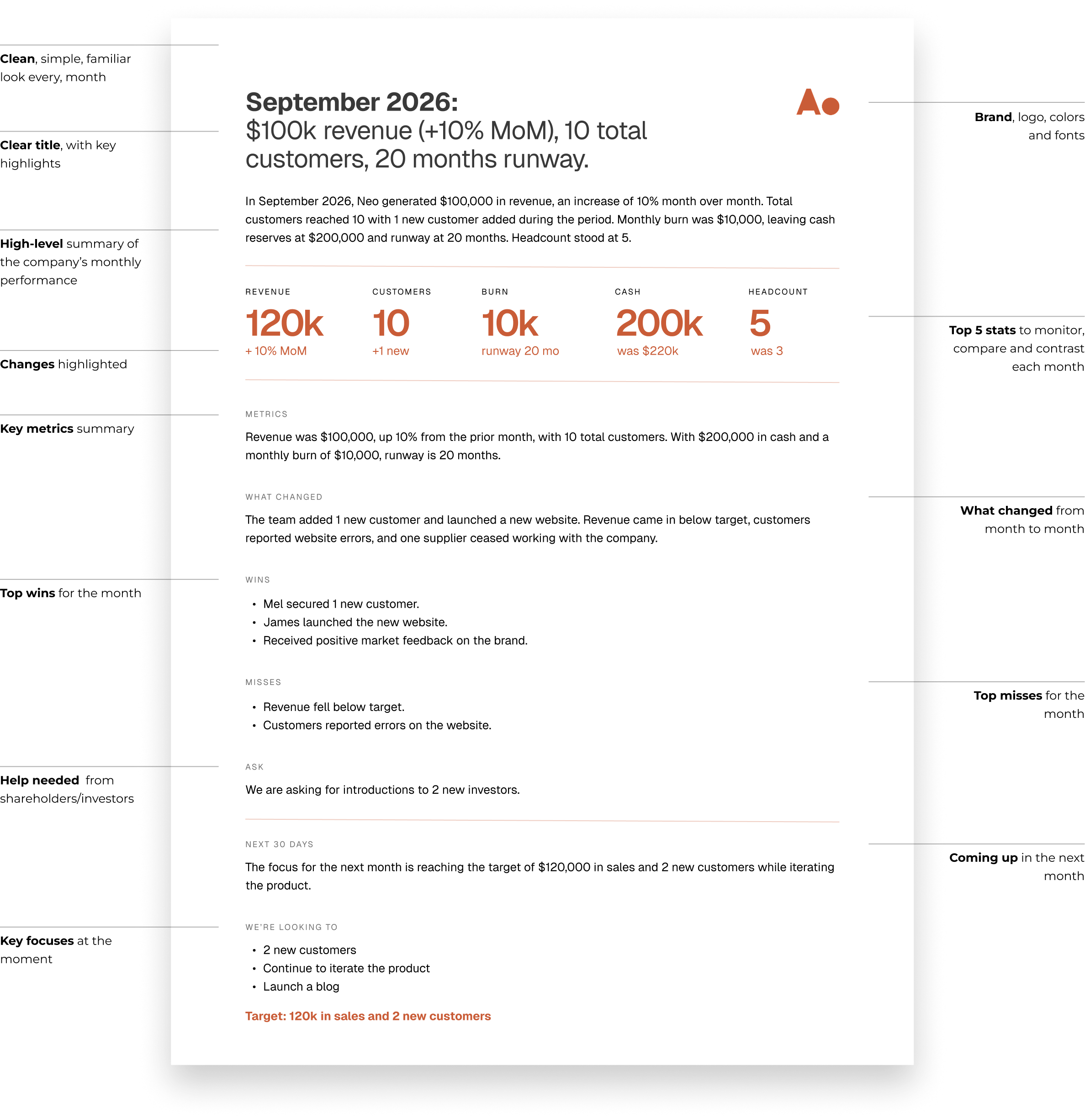
A filled template. Plan, actual, and one miss are on the same page.
A vision paragraph does not belong, and neither does a restatement of the deck. Screenshots of the product with no number attached do not belong. Thanks to every investor by name do not belong, unless someone did a specific thing you can describe. A forecast with no actual beside it does not belong. “We are excited” does not belong. Excited is not a number.
Write from the numbers you have, not from the week you wish you had. If revenue missed the plan, put the reason in the sentence beside the number, where it will be seen, rather than in a note further down. Keep last month’s list on the page, marked done or deferred. If a section has nothing in it, omit the heading as well as the text. A heading with nothing under it looks like you ran out of courage. The whole investor update should fit on one page.
Questions people ask
What should every investor update include? A two-line summary, revenue or the nearest count, cash, burn, runway, plan against actual, what changed, and the list from last month.
How long should an investor update be? One page. If it needs an appendix, it is not ready to send.
How many metrics are enough? Four, plus one that is specific to the business. Adding a sixth because it improved is how the block stops being trusted.
What if there is no news? Send it anyway, shorter. Cash and runway are news. A gap is read as concealment.
Knowing what to include is the easy part. Finding last month’s numbers, and the list you wrote, is what makes the investor update late. OnRecord keeps both, sets plan beside actual, and leaves empty sections off the page. The sections above are the ones it asks for.
I built OnRecord after years of doing this the hard way – putting investor comms off, then overbuilding them to compensate. What they wanted, and what I later understood as an investor myself, was a single-page update I could send without the drama – including just the essentials: last month still on the record, the key numbers (next to the plan), and nothing written to fill the space. That’s what OnRecord does. A monthly update for investors, shareholders and anyone else who needs the same picture – made in ten minutes. Try for 60 days free – that’s 2 free monthly updates. Your investors will love you for it!
All the info they want, nothing they don’t.


