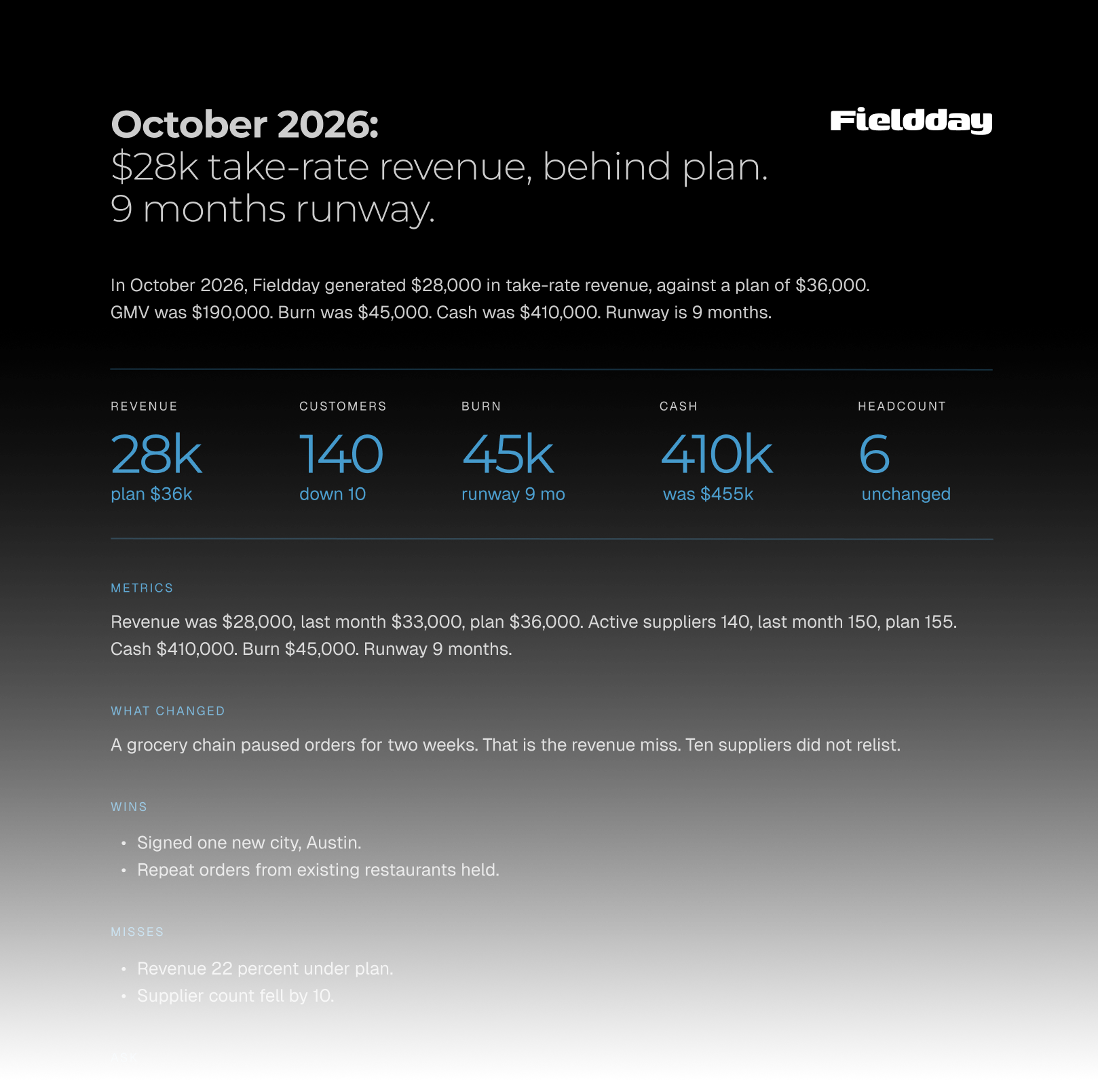
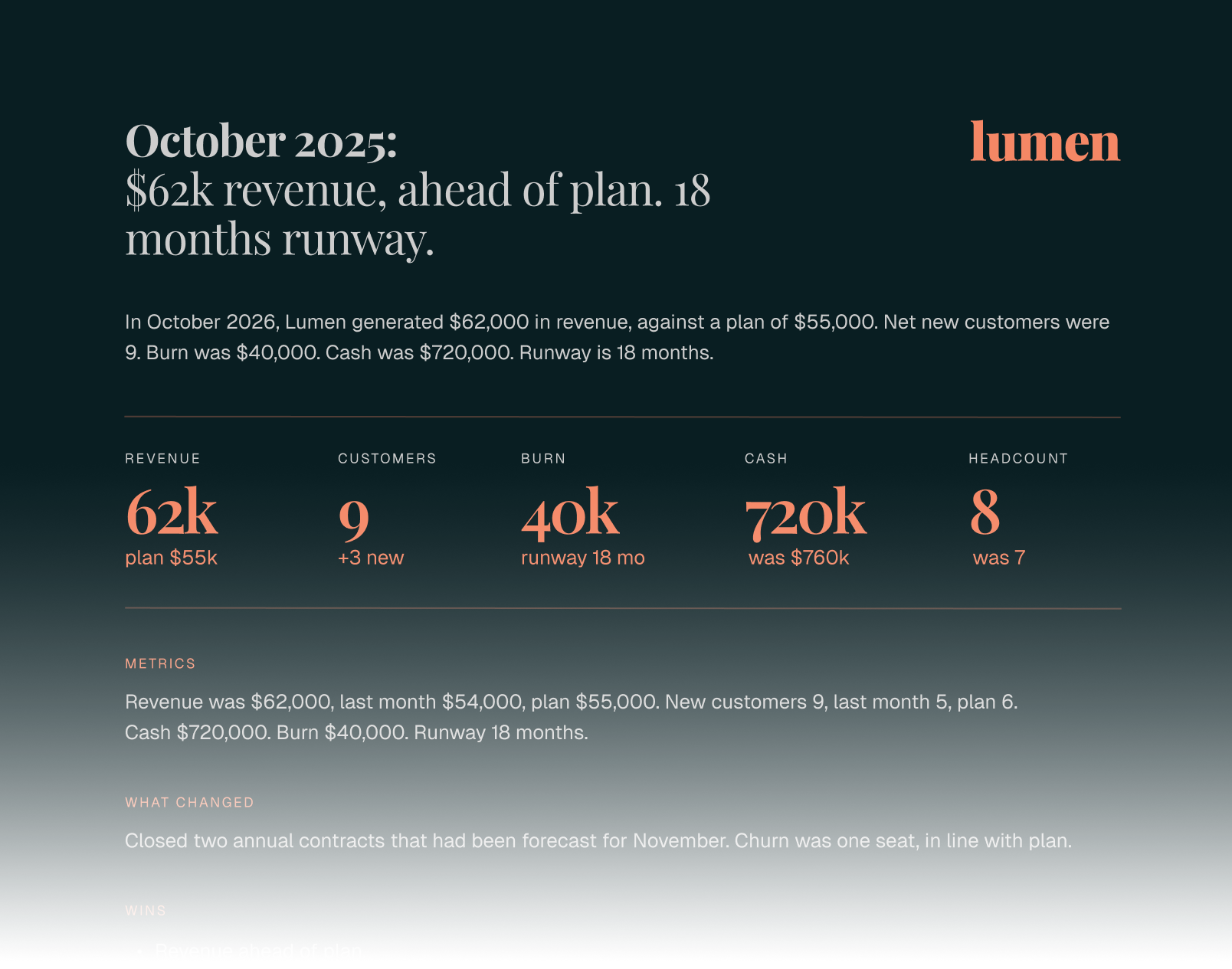
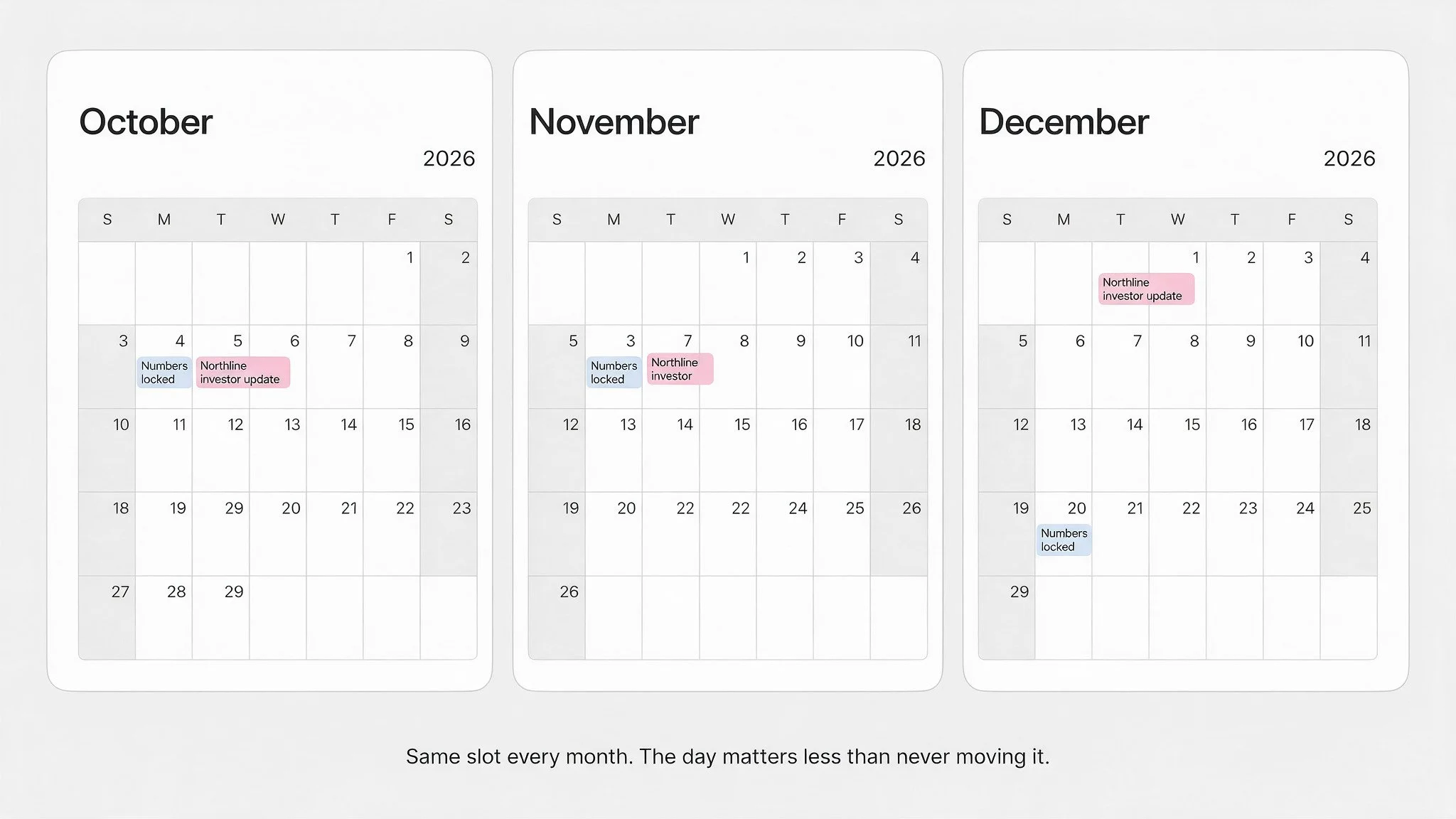
Send investor updates monthly. Same week every month, starting the month after the money lands, and keep going in good months and bad. Quarterly comes later, once you have a proper board rhythm and a company whose numbers take more than a month to move. For most companies that is somewhere after Series A, not at seed.
That is the whole answer. The rest of this post is about why it holds, and how to keep it up once the novelty wears off, which is usually around month three.
For years my cadence was "when there's something worth saying." In practice, that meant after a good month. A bad month never felt worth saying, so I waited for the next one. Then the next one was only fine, so I waited again. By the time I wrote, the gap was the story, and the update had to explain the silence before it could explain the business.
When I started investing myself, I saw what that looked like from the other side. The founders I trusted most were not the ones with the best months. I knew when to expect them. Their update arrived in the first week, whatever had happened. When one of them went quiet, I didn't assume they were busy. I assumed something had gone wrong and I would be the last to hear.
The short answer: monthly, same week, every month
Pre-seed to Series A: monthly. This is the common default, and for good reason.
Later, with a real board rhythm: quarterly can work, often with the key numbers still going out monthly in between.
Always: the same slot every time. The day you pick matters less than the fact that it never moves.
If you only take one thing from this post: a monthly update that arrives every month beats a better-written one that arrives when you feel ready.
Why monthly works at the early stage
Your numbers move monthly. At seed, one customer, one hire or one slipped launch can change the picture. A quarterly update reports a company that no longer exists. A monthly one reports the company your investors actually own.
Your asks expire. If you need an introduction to a hiring manager, a pilot customer or a bridge investor, you need it this month. An ask that waits for the quarter has often stopped mattering by the time it lands.
No single update has to carry much weight. This is the part I underrated. When the next update is thirty days away, a thin month is just a thin month. You report it and move on. When the next one is ninety days away, a thin quarter reads like a trend, and you feel pressure to dress it up.
It is less work, not more. That sounds backwards, but it isn't. A monthly update starts from last month's page. You change the numbers, mark last month's list done or deferred, and write two lines on what happened. A quarterly update starts from memory, and memory takes much longer.
“Wait until there's something worth saying” is the trap
Cadence based on news is not a cadence. It means you send when the month went well and go quiet when it didn't, and investors learn to read the silence. It is the worst signal you can send, because it says something is wrong without saying what.
A fixed cadence takes the decision away. You are not choosing whether this month deserves an update. It's the first week, so the update goes out. That is the point of the habit: it protects you from yourself in exactly the months you would rather say nothing.
The months with nothing to report are also the ones investors most need to see. Cash still went down. Runway still moved. The plan either held or it didn't. "Not much changed, and here is the page" is useful. A missing update just makes people guess.
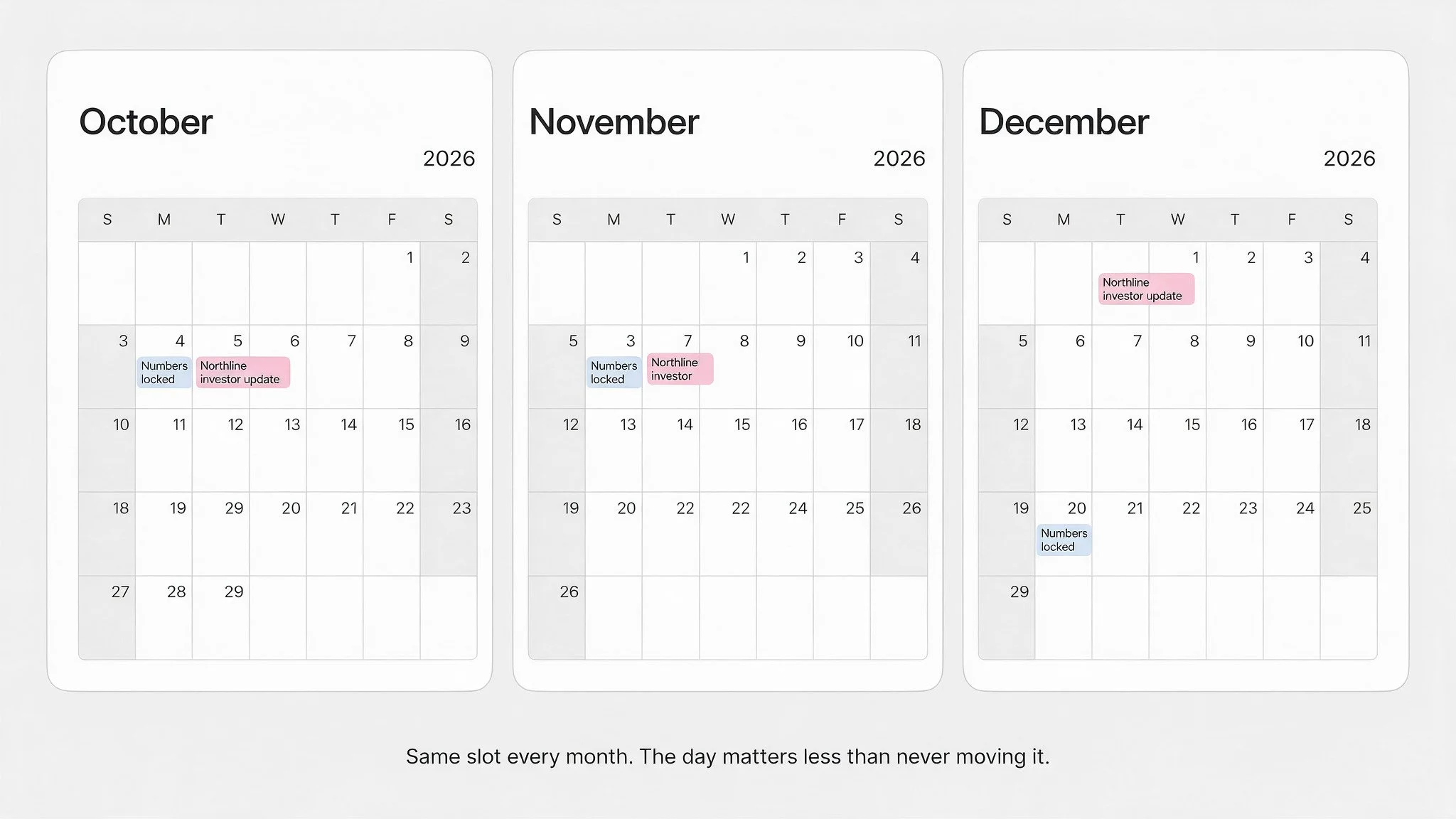
Calendar showing a recurring monthly investor update on the first Tuesday of each month.
Monthly vs quarterly investor updates
This is not a matter of taste. It depends on how fast the company changes and what other reporting is already happening.
Monthly fits when:
you are pre-seed, seed or Series A
revenue, burn or the plan can move meaningfully in a month
you have angels or small funds who don't sit on your board and get no other view of the company
runway is short enough that insiders would need warning to help
Quarterly fits when:
you have a board that meets quarterly and gets a full pack
the metrics that matter genuinely take a quarter to move
your update is essentially the readable summary of that board pack
Even then, a lot of later-stage companies keep a short monthly page with just the numbers, and save the narrative for the quarter. That hybrid is often the best of both: investors still see cash and plan vs actual every month, and you only write the longer story four times a year.
What doesn't work is choosing quarterly at seed because monthly feels like overhead. Each update then becomes a production. The production gets postponed. And the postponement becomes the thing your investors notice.
Two situations that change the rhythm
When you are raising. You may send short progress notes more often to the people you are talking to about the round. That is a fundraising tool, not your investor update. Keep the monthly update going to your existing investors on its normal day. They are the ones prospective investors will call.
When runway is short. Do not drop to quarterly to avoid showing the number. This is when your existing investors most need the monthly page, because they are the people who might bridge you, and they need time to decide. Bad news with three months to act on it is a conversation. Bad news with three weeks is a crisis.
Picking your slot
Choose a working day early in the month, once last month's numbers are close enough to trust. For most early-stage companies that is somewhere in the first week. Then put two things in your calendar as recurring events:
Numbers locked. A day or two before the send. This is when you stop waiting for the books to be perfect. Close enough is close enough, and you can note anything provisional on the page.
Update sent. The slot itself. Treat it like a board meeting you can't move.
Early in the month beats late. The numbers are fresh rather than reconstructed, and your ask lands while investors are planning their month rather than clearing it out.
Don't over-optimise the day. First Tuesday, the 5th, the third working day: they all work. What matters is that your investors can predict it and you never have to decide again.
Making monthly cheap enough to keep
Monthly only holds if each update is small. If it takes a weekend, you will skip it the first time a weekend is busy, and that is the start of the gap.
A few things keep it small:
Same format every month. The same numbers in the same order, with last month and the plan beside each one. Investors learn where to look, and you stop designing the page from scratch. The monthly investor update template is the structure I use.
Start from last month's page, not a blank one. Copy it, update the numbers, and work through last month's list.
Empty sections stay off. No hires this month? No hiring section. Don't write filler to make the page look busy. What actually earns a place on the page is covered in what to include in an investor update.
One page. If it is running over, you are writing commentary the numbers don't need.
A short page you recognise every month is worth more than a long one that changes shape every time it arrives.
If you have already skipped months
Don't try to catch up. Don't send a three-month epic covering everything you missed, and don't wait for a good month to restart on. That is the same trap again.
Send this month's update, on the normal format, with one line at the top: it is later than it should be, and from now on it will arrive on a set date each month. Then send the next one on that date. The second on-time update does more to repair the gap than any explanation in the first. I wrote more about why this happens in the investor update I kept avoiding.
Changing cadence later
When the time comes to move from monthly to quarterly, say so. Put one line in the last monthly update: what is changing, what investors will still get every month (if anything), and the date of the first quarterly update.
Then keep the new rhythm as strictly as you kept the old one. Moving to quarterly is fine. Drifting to "every couple of months" without telling anyone looks like the company is going quiet.
Questions people ask
How often should I send investor updates? Monthly from pre-seed to Series A, in the same week each month. Move to quarterly later, once a board rhythm takes over, and tell investors before you switch.
Is quarterly ever fine at seed? Only if you will actually send every one on time, and the company really doesn't change much month to month. A quarterly update that always arrives is better than a monthly one that keeps slipping. But most founders who choose quarterly at seed are choosing it to make the work less frequent, and it usually makes each one harder.
What if nothing happened this month? Send it anyway. Cash moved, runway moved, and the plan either held or it didn't. A short page saying so is the update.
What if no one replies? That is normal. Most months, no replies means the page answered the questions before anyone had to ask. It's not a reason to send less often.
Should I send more often when things are going wrong? Keep the monthly page on schedule. If something big happens between updates, like losing a major customer or a key person leaving, tell your lead investors directly and then put it on the next page as normal.
What day of the month should I send it? Early, once last month's numbers are close enough to trust. The exact day matters far less than keeping it the same.
The cadence is easy to decide and hard to keep. What breaks it is never the decision. It's the hour you lose each month finding last month's numbers, last month's list and the plan you wrote back in January. OnRecord exists to make that part small: you fill in a short form once a month, and it gives you the same one-page update, with last month and the plan already beside each number.
I built OnRecord after years of doing this the hard way – putting investor comms off, then overbuilding them to compensate. What they wanted, and what I later understood as an investor myself, was a single-page update I could send without the drama – including just the essentials: last month still on the record, the key numbers (next to the plan), and nothing written to fill the space. That’s what OnRecord does. A monthly update for investors, shareholders and anyone else who needs the same picture – made in ten minutes. Try for 60 days free – that’s 2 free monthly updates. Your investors will love you for it!
All the info they want, nothing they don’t.