
This investor update example is a full month for a seed-stage company, written the way an investor prefers to read it. Revenue was ahead of plan. Onboarding was behind. Both are on the page and important.
Note: the company is fictional, but I am using it for illustrative purposes so you can follow along with your own company.
An example is useful when it is honest – investors will appreciate it. If the month was good, say it was good. If revenue missed what you wanted, put that in too. The example template below shows both.
Investor update example: (Northline, September 2026)
Subject: Northline update — September 2026
September revenue was $41k, against a plan of $38k. Onboarding slowed, and two clinics that signed in August are not live yet. Runway is 11 months, the same as the plan.
Revenue: $41k. Last month $37k. Plan $38k.
Cash: $420k. Last month $455k. Plan $430k.
Burn: $35k. Last month $33k. Plan $34k.
Runway: 11 months. Last month 12. Plan 11.
Clinics live within 30 days: 58%. Last month 71%. Plan 70%.
We signed Harlow, our first group of clinics. Four sites. That is why revenue beat plan. The miss is onboarding. Two clinics from August are still in setup, because the implementation lead left on the 12th and those hours were not covered. A contractor starts on the 5th of next month. I do not expect the 30-day number to recover in October.
Done: shipped the billing export Harlow asked for. Hired the support generalist. Deferred from August: clinic-admin permissioning. Still open. It is now blocking one of the two clinics, so it is on October’s list.
October: cover the implementation hours, get both August clinics live, and send Harlow the group rollout plan by the 15th.
Ask: an introduction to an implementation lead who has onboarded multi-site clinics, on US hours.
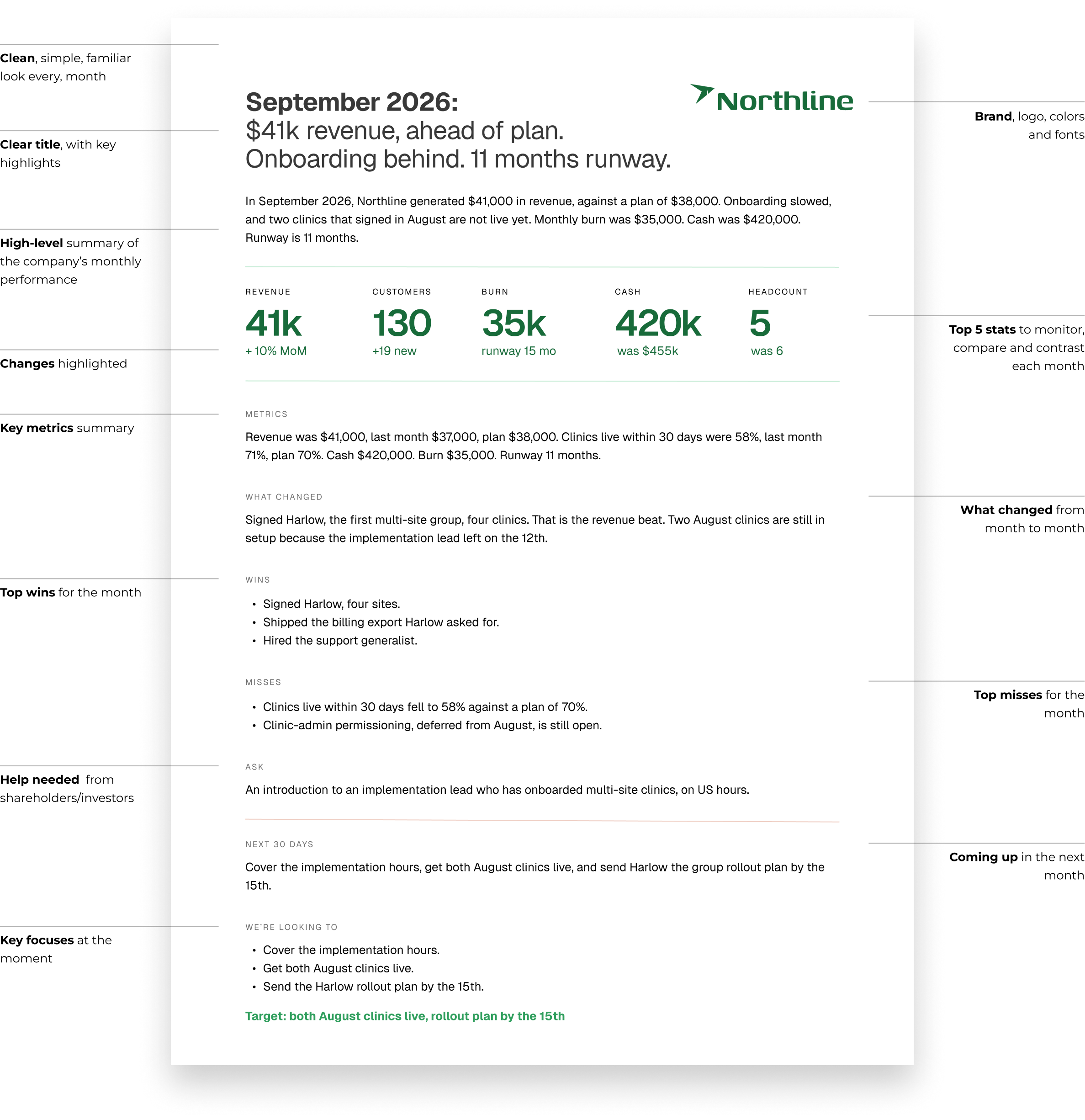
A filled template. Plan, actual, and one miss are on the same page.
How to read this investor update example
The summary says both things. Revenue was ahead, and onboarding was behind. The numbers repeat that, each with last month and the plan beside them, so a reader does not have to hunt for the comparison.
The win is named. Harlow, four sites. The miss has one reason, the lead leaving on the 12th, and a date, the 5th. There is no second excuse.
August’s unfinished item is still on the page, with August next to it. It did not disappear because the month changed. The ask is one introduction, specific enough that someone could forward it.
If your month has no miss, leave that part out. Do not invent one, and do not fill the space with a paragraph about the market. Empty sections stay off the page.
Questions people ask
What does a good investor update example include? A two-line summary, the numbers against last month and against plan, what changed, the list from last month, and an ask only if you have one.
Does it have to include bad news? No. It has to include the truth. A good month should read as a good month. A mixed month should show both, in the same place.
How long should it be? One page. This example is the length.
OnRecord generates this page from the form. Plan and actual sit on the same line, and last month’s list is already there to mark done or deferred. The example above is one it produced.
I built OnRecord after years of doing this the hard way – putting investor comms off, then overbuilding them to compensate. What they wanted, and what I later understood as an investor myself, was a single-page update I could send without the drama – including just the essentials: last month still on the record, the key numbers (next to the plan), and nothing written to fill the space. That’s what OnRecord does. A monthly update for investors, shareholders and anyone else who needs the same picture – made in ten minutes. Try for 60 days free – that’s 2 free monthly updates. Your investors will love you for it!
All the info they want, nothing they don’t.


