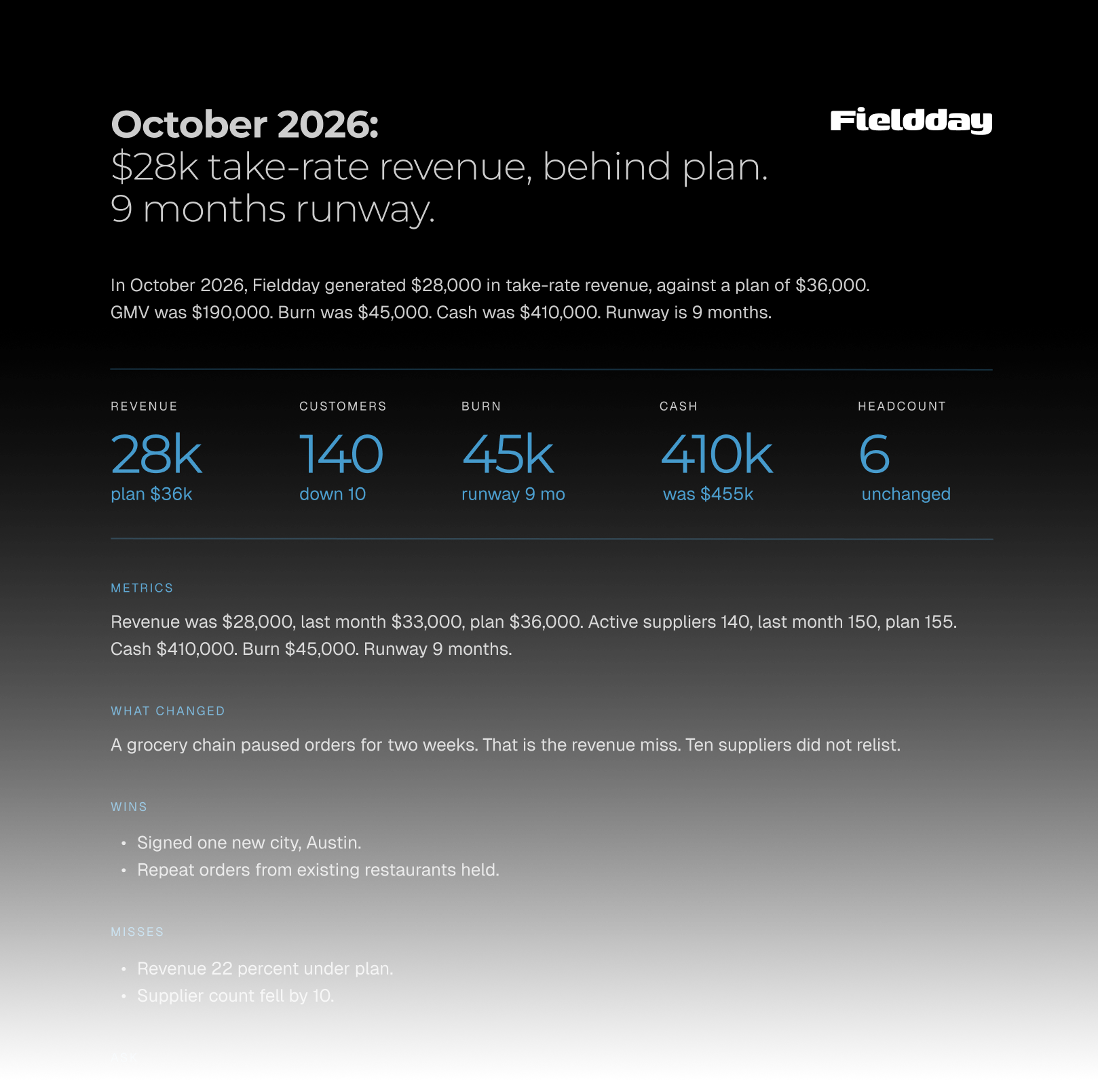
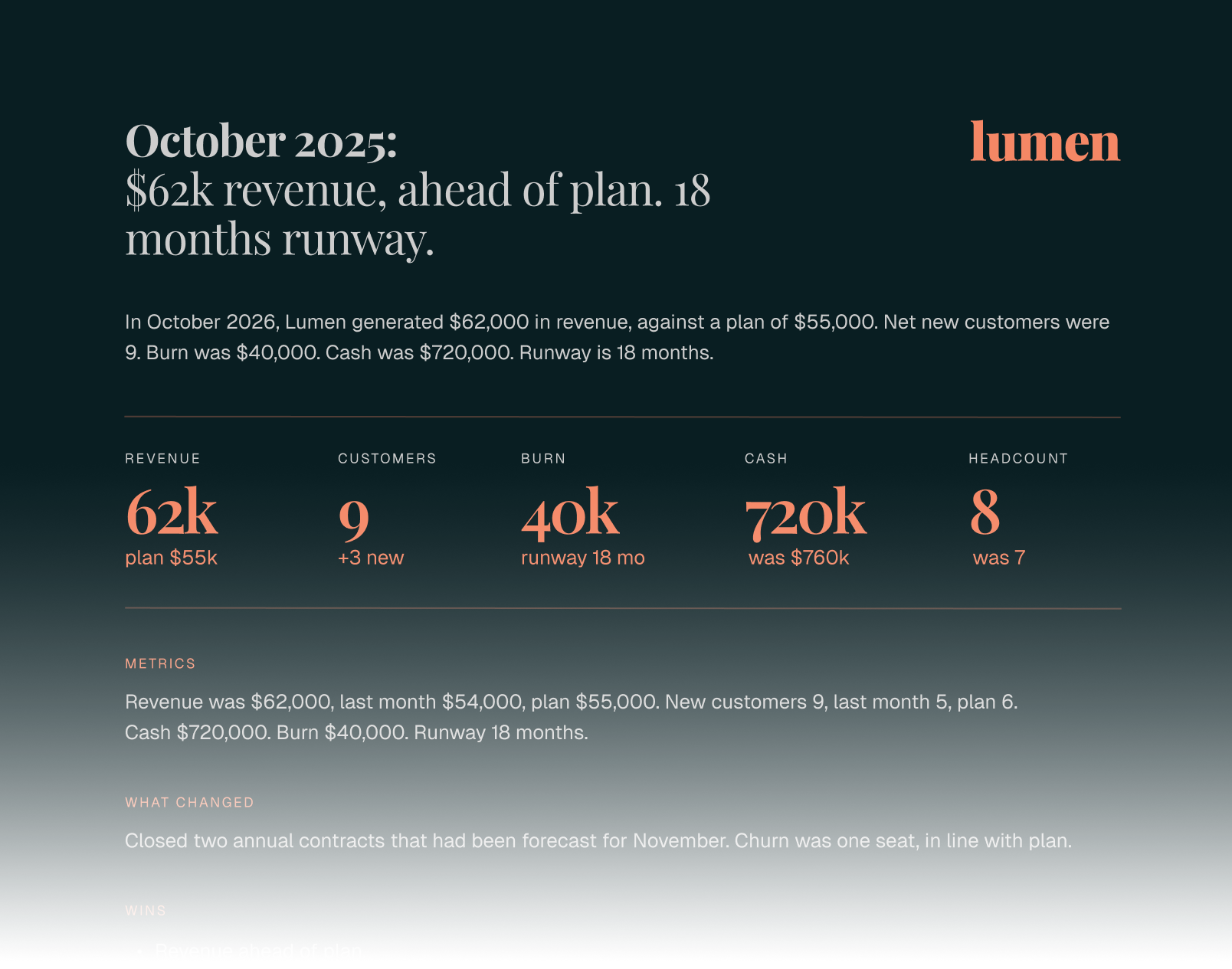
The mistake is the same every time a month goes wrong. You bury the miss under three wins, or you wait for a better month so the page feels easier to send. Both read as theatre. Investors notice the silence, or they notice the highlight reel, and either way they stop trusting the page.
Put the hard thing first. What happened. What it did to the number next to the plan. What you are doing about it. The ask, if you have one. Same one-page monthly habit as every other month. Bad months are when that page matters most.
I used to do the opposite. A slipped launch or a churned customer went in a paragraph after the good news, padded with context so it sounded smaller than it was. Or I skipped the month entirely and told myself I would catch up when there was something worth saying. From the investor side, both patterns said the same thing: the founder only writes when the story is flattering.
When I started investing, the founders I trusted were not the ones with perfect months. They were the ones whose update still arrived on time, with the miss on line one, the impact beside the plan, and a short plan with an owner. I did not need a crisis deck. I needed the ordinary page to tell the truth.
The core rule: hard thing first
On a tough month, the page should answer four questions in order:
What happened. One or two plain sentences. Name the miss. Do not open with a softener.
Impact next to the plan. The number that moved, with last month and the plan beside it, so nobody has to reverse-engineer how bad it is.
What you are doing. The next step, with an owner and a date. Not a vibe. Not "we are focused on recovery."
The ask, if you have one. Specific and forwardable. If you do not need help, skip the line. Do not invent an ask to look proactive.
That is the whole structure. Everything else on the page — cash, runway, last month's list, next 30 days — stays in its normal place. You are not writing a different format for bad news. You are writing the same format with the hard thing at the top.
Highlight reel vs a plain page
A highlight-reel update opens with three wins, buries the miss, and ends with optimism that is not on the numbers. It takes longer to write, and it teaches investors to skim past the good news looking for what you left out.
A plain page puts the lowlight beside the numbers. The miss is visible in the same place every month. Last month and the plan are already there, so the gap does not need a speech. That is why the same one-page habit works in a bad month: the structure does the honesty for you, as long as you do not edit the miss out.
If you find yourself rewriting the opening three times to make it land softer, stop. Soft is what makes it worse. Clear is what makes it usable.
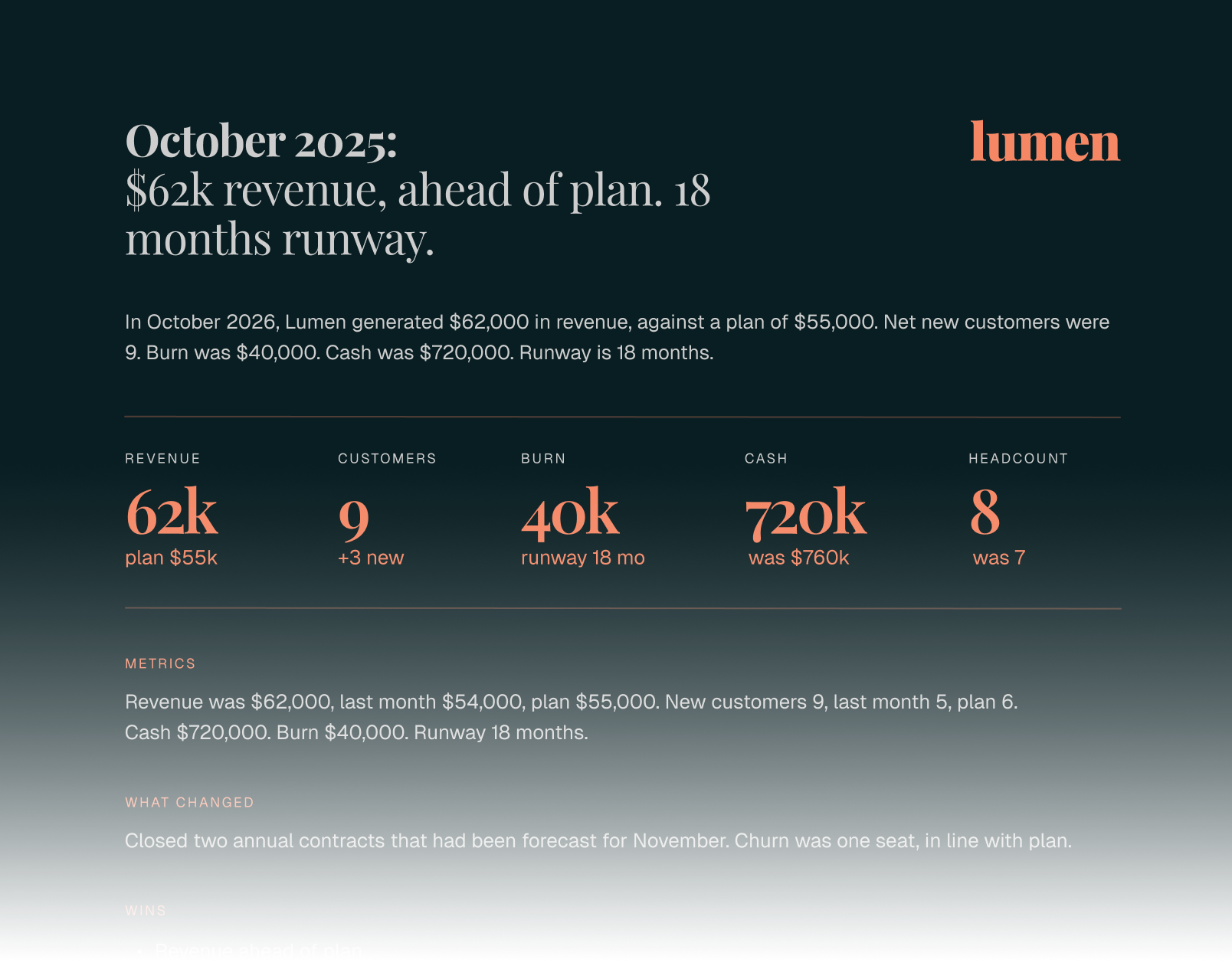
A clean one-page investor update design
A practical structure for a tough month
Use the same sections you use every month. Change the order of attention, not the format.
Open with the miss. Example shape (illustrative, not a real company): "Northline missed MRR plan this month. Two enterprise deals that were in forecast slipped past month-end. Cash and runway are on the page below." That is enough. Context can wait one sentence.
Show the number next to the plan. Do not make investors hunt. If revenue, burn, runway or a key operating metric moved, put Actual / Last month / Plan in the same row as always. A miss without the plan beside it forces people to email you. A miss with the plan beside it lets them help.
Own the next step. One line: what you will do, who owns it, by when. "Re-forecast enterprise pipeline with [Name] by Friday; cut two non-critical hires this week." Vague recovery language ("doubling down", "laser focused") is filler. Cut it.
Keep last month's list honest. Tick what shipped. Mark what slipped. Deferred items stay on the list with a new date. Deleting a miss from last month's promises is another form of burying it.
Cash and runway stay visible. Especially in a bad month. Hiding runway until it is short is how a miss becomes a crisis. Put the number on the page while there is still time to act.
Ask only if it is real. Intro to a hiring manager. Warm path into a customer. A bridge conversation with a clear amount and timing. If you have nothing specific, leave the ask off. A fake ask after bad news reads like panic.
You do not need a separate "crisis email" format for an ordinary tough month. Keep the monthly page. If something breaks between updates — a key person leaves, a major customer churns mid-month — tell your lead investors directly, then put it on the next page in the normal place. The monthly investor update template is the structure; bad news does not get a different one.
What not to do
Do not pad the top with wins. Wins can sit lower on the page. Leading with them after a miss makes investors work to find the truth.
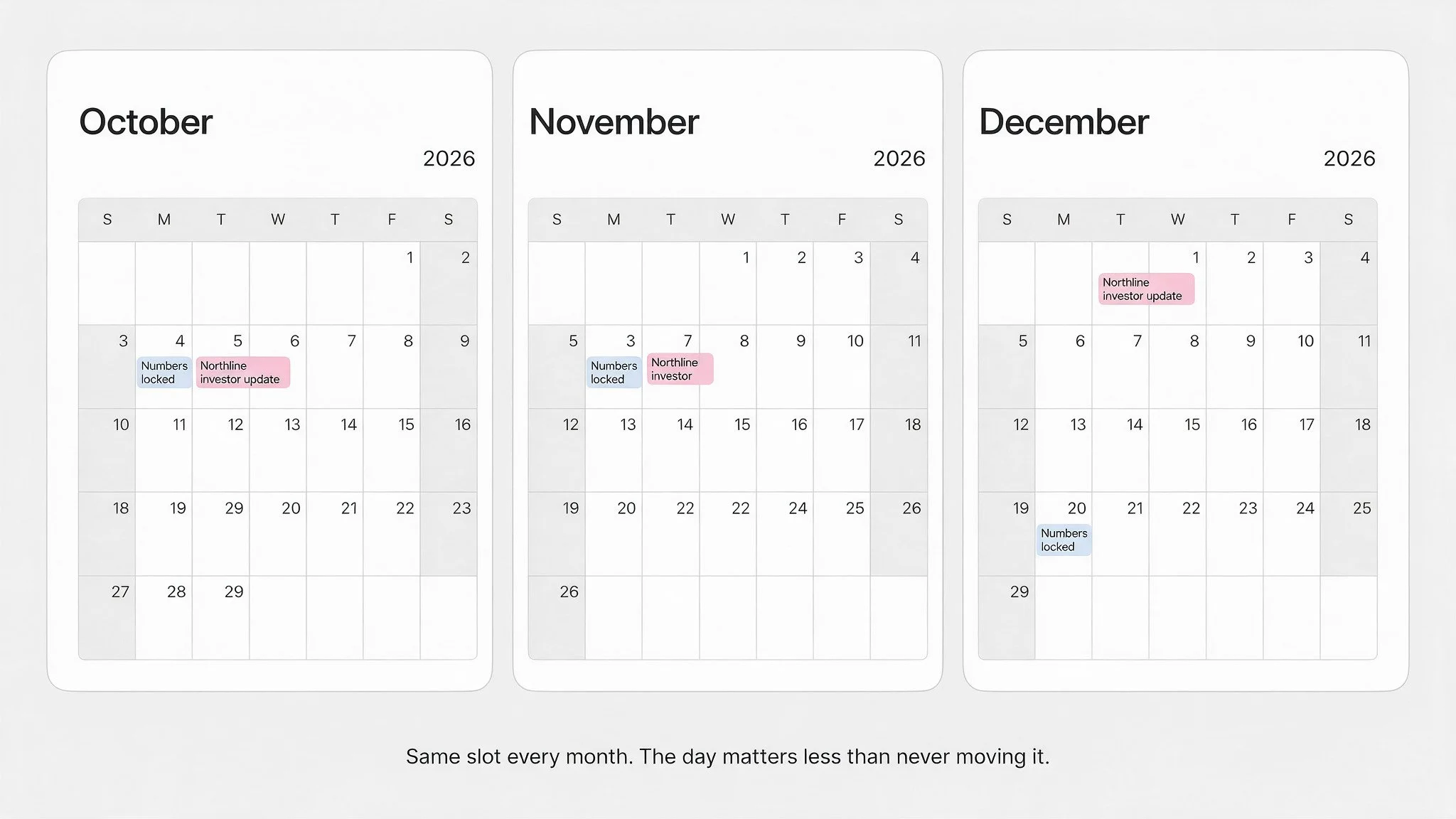
Do not go quiet until the month feels good again. Silence is louder than a plain miss. The cadence post covers why monthly holds in thin months; the short version is: send on the normal day.
Do not write a three-page apology. One clear miss, one clear impact, one clear next step. Length is usually where founders hide.
Do not wait for perfect numbers. Close enough, labelled if provisional, beats a late masterpiece. Investors would rather see the miss on time than a polished version two weeks later.
Do not treat bad news as a reason to redesign the update. New sections, new charts, a sudden deck — that is theatre again. Same page. Harder truth.
Why the same page works when the news is bad
A page that already carries last month and the plan next to each number makes burying the miss harder. You would have to delete a column or invent soft language to hide the gap. That friction is useful. It is also why a blank page after a bad month feels so heavy: you are writing the miss and reconstructing the plan from memory at the same time. Starting from last month's page removes half of that.
I wrote about the avoidance loop separately in the investor update I kept avoiding. This post is the other half: once you are writing, how to put the bad news on the page without sanding it off. For what earns a place on the page in any month, see what to include in an investor update.
Questions people ask
How do you write an investor update with bad news? Lead with what happened, show the impact next to the plan, state what you are doing with an owner and a date, and add a specific ask only if you have one. Same one-page format as every other month.
Should I wait for a better month? No. Waiting trains investors to read silence as trouble, and the catch-up update then has to perform. Send on the normal day.
Do I need a separate crisis email? For an ordinary tough month, no — use the monthly page. For something material that cannot wait, tell lead investors directly, then put it on the next update.
Where do the wins go? Below the miss, or in their normal section. They should not open the page when the story of the month is a miss.
What if I do not know the fix yet? Say that in one line, and put the date by which you will know. "Still diagnosing churn in the mid-market cohort; answer by the 12th" is better than fake certainty.
Will investors panic? Clear bad news with a plan rarely causes panic. Ambiguous updates and missing months do. Your job is to make the page usable, not cheerful.
Bad months are when the habit pays off. The founders who keep the page honest when it hurts are the ones investors still answer when they need help. OnRecord makes that honesty cheaper: last month and the plan sit beside each number before you write the sentence about the miss, so the page is already harder to turn into a highlight reel.
I built OnRecord after years of doing this the hard way – putting investor comms off, then overbuilding them to compensate. What they wanted, and what I later understood as an investor myself, was a single-page update I could send without the drama – including just the essentials: last month still on the record, the key numbers (next to the plan), and nothing written to fill the space. That’s what OnRecord does. A monthly update for investors, shareholders and anyone else who needs the same picture – made in ten minutes. Try for 60 days free – that’s 2 free monthly updates. Your investors will love you for it!
All the info they want, nothing they don’t.